
Today, more and more organizations are moving to the public cloud and choosing open source databases. They are choosing this for a variety of reasons, but license cost is one of the main ones.
In this post, we will review some of the common alternatives for running MySQL database inside a managed environment.
Legacy applications may be a reason for manually deploying and managing MySQL database.
Although it is possible to deploy a virtual machine, and above it manually install MySQL database (or even a MySQL cluster), unless your organization have a dedicated and capable DBA, I recommend looking at what brings value to your organization. Unless databases directly influence your organization’s revenue, I recommend paying the extra money and choosing a managed solution based on a Platform as a Service model.
It is important to note that several cloud providers offer data migration services to assist migrating existing MySQL (or even MS-SQL and Oracle) databases from on-premise to a managed service in the cloud.
Benefits of using managed database solutions#
- Easy deployment – With a few clicks from within the web console, or using CLI tools, you can deploy fully managed MySQL databases (or a MySQL cluster)
- High availability and Read replica – Configurable during the deployment phase and after the product has already been deployed, according to customer requirements
- Maintenance – The entire service maintenance (including database fine-tuning, operating system, and security patches, etc.) is done by the cloud provider
- Backup and recovery – Embedded inside the managed solution and as part of the pricing model
- Encryption at transit and at rest – Embedded inside the managed solution
- Monitoring – As with any managed solution, cloud providers monitor service stability and allow customers access to metrics for further investigation (if needed)
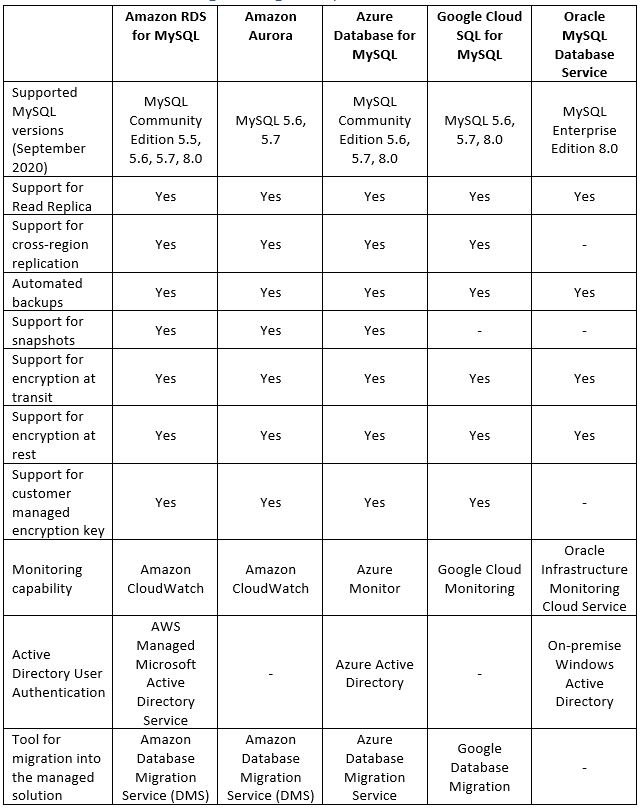
Alternatives for running managed MySQL database in the cloud#
Summary#
As you can read in this article, running MySQL database in a managed environment in the cloud is a viable option, and there are various reasons for taking this step (from license cost, decrease man power maintaining the database and operating system, backups, security, availability, etc.)
References#
https://aws.amazon.com/rds/mysql/
https://aws.amazon.com/rds/mysql/pricing/https://aws.amazon.com/rds/aurora/
https://aws.amazon.com/rds/aurora/pricing/https://azure.microsoft.com/en-us/services/mysql/
https://azure.microsoft.com/en-us/pricing/details/mysql/https://cloud.google.com/sql
https://cloud.google.com/sql/pricing#2nd-gen-pricinghttps://www.oracle.com/middleeast/mysql/
https://www.oracle.com/middleeast/mysql/pricing.html